
By Sandra Tanner

Storyline
The Book of Mormon contains the purported stories of three different groups which sailed to the Americas.
Jaredites
- The Jaredites (Book of Ether) came to the new world at the time of the tower of Babel. They were instructed to build eight barges in which to sail to America. This journey took 344 days. After years of occupying the land and numbering in the millions, their civilization was destroyed by war. The last survivor, Coriantumr, was found by the Mulekites sometime before 200 B.C.
Mulekites
- The Mulekites came to America from Jerusalem in 586 B.C. They were led by the last living son of Zedekiah, Mulek. Although they lived in America during the same period as the Nephites and Lamanites, they did not encounter each other until around 200 B.C. They then became amalgamated with the Nephites.
Lehi and family
- An Israelite prophet named Lehi is warned by God to flee Jerusalem at 600 B.C. He and his family make their way to the southern part of Arabia, where they build a ship to sail across the Pacific Ocean to America. Two of his sons, Nephi and Laman struggle for leadership. This leads to the division of the group into two warring factions, the Nephites (usually the good guys) and Lamanites (usually the bad guys).
- The last battle between the two groups, in 421 A.D., wipes out almost all of the Nephites. Moroni, the last surviving Nephite, buries the records of his civilization (on golden plates) in the hill Cumorah. Hundreds of years later, Joseph Smith is directed to the spot by Moroni (some records say Nephi), now a resurrected being who has become an angel. He then claims to translate the Book of Mormon from those plates.
Translation
The Urim and Thummim, specially prepared spectacles preserved with the golden plates as an aid in translating, were used to translate the first 116 pages of the Book of Mormon, up to the first part of the book of Mosiah. This was on the plates of Lehi. Then, when one of Joseph Smith’s supporters, named Martin Harris, lost the 116 manuscript pages, Smith was told by God not to translate the same material again. He was to now switch to the small plates of Nephi, which were more religious in content than the other plates. This record was translated by using a magic stone that Smith found in a man’s well. Those who were on the scene when Smith worked on his translation recount that he gazed at the stone in his hat and would read the words off the stone to his scribe.

(Drawing by Michael Clane Graves, as printed in The Creation of the Book of Mormon: A Historical Inquiry by LaMar Petersen.)
Smith claimed to copy off some of the characters from the plates. This sample of supposed Nephite writing is a composite of various scripts and squiggles, with English characters in abundance. No other example of this type of writing has ever been found. The Mayans were the only Indians to develop a written language and it has no resemblance to Smith’s supposed Book of Mormon characters.
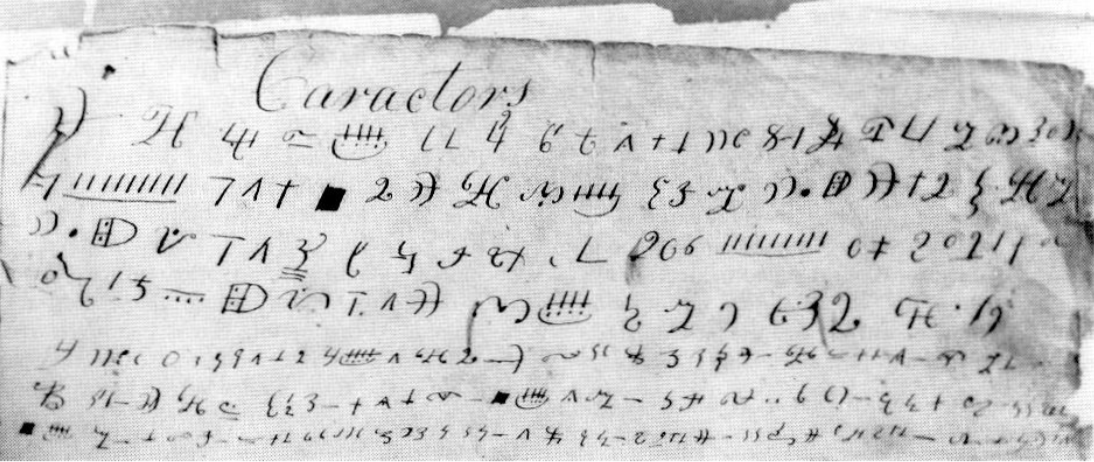
Purported sample of Nephite script from the Book of Mormon plates

An example of typical Mayan writing glyphs
Testing the Record
How do we authenticate the Book of Mormon?
Does history agree with it?
The Mormons like to point to the great buildings of the Maya in southern Mexico and central America as proof that such a culture described in the Book of Mormon did exist. However, the Maya were a pagan people with many deities and human sacrifice. The Book of Mormon people were supposed to be Israelites led by a prophet of God.
The Bible presents the history of Israel and the beginnings of Christianity. There are thousands of artifacts relating to the people mentioned in the Bible. Also, many of the cities mentioned in the Bible have been excavated. The journeys of Paul can be charted on a map. If the Book of Mormon is a history of actual people we would expect to find the same type of evidence for it as we do for the Bible.
Problem Areas
As we examine the Book of Mormon we must evaluate the people’s living conditions with that of the Indians. What type of plants does the book mention? Were these plants in America at that time? What animals are said to be in the area? Did the Indians have the knowledge of metal working, as mentioned in the Book of Mormon? What was their written language? What was their mode of travel? How do these claims compare with archeology?
The Book of Mormon mentions:
- wheat (Mosiah 9:9)
- horses (1 Nephi 18:25)
- chariots (Alma 18:9-11; 20:6; 3 Nephi 3:22)
- cows (Enos 21)
- elephants (Ether 9:19)
- silk (Alma 1:29; 4:6; Ether 9:17)
- linen (Mosiah 10:5; Helaman 6:13; Ether 10:24)
- money (pieces of gold and silver) (Alma 11:3-20)
- steel (2 Nephi 5:15; Jarom 8; Ether 7:9)
However, none of these items were in the Americas before the Spaniards’ arrival.

Doctrine
Many people assume that if they read the Book of Mormon they will get a good idea of LDS beliefs. However, the Book of Mormon teaches one God, not plural gods, as in later Mormonism. Likewise, it mentions heaven and hell, not three degrees of glory. Nor are key LDS doctrines like temple marriage, secret temple ceremonies, baptism for the dead, a pre-existence of man, eternal progression or polygamy anywhere to be found in the Book of Mormon.
One of the most objectionable doctrines in the Book of Mormon is it’s view of skin color. White skin is seen as desirable, dark skin is seen as a mark of God’s displeasure (see our page on Racial Statements in LDS Scripture). Smith wrote the Book of Mormon in the late 1820’s. Over the next fifteen years his doctrines, such as those mentioned above, underwent radical changes.
Contemporary Influences
There were a number things in Joseph Smith’s environment, such as cultural ideas, books and newspaper stories, family experiences, biblical debates, etc., which seem to have influenced his writing of the Book of Mormon. Below are some of the most prominent ones, with references where their effects can be seen.
| Influences | Effects |
|---|---|
| Secret bands like the Freemasons | Alma 37; Ether 8:18; Helaman 6:21-23 |
| Arguments over infant baptism and the eternal fate of the un-churched | Moroni 8 |
| Indians originating from Israelites | Book of Ether; 1 Nephi 18 (see: View of the Hebrews, published in 1825) |
| King James Bible quotations | New Testament phrases appear in Old Testament portion of Book of Mormon |
| Joseph Smith’s father’s dreams | 1 Nephi, chapters 8-11 (see: Lucy Smith’s book: Biographical Sketches of Joseph Smith the Prophet and His Progenitors for Many Generations) |
| Cursed treasures | Mormon 1:18 (like money digging stories in New York) |
| Freemen | Alma, chapters 51, 60-62 (like the American revolution) |
Is Ezekiel 37:15-22 a Prediction of
the Book of Mormon?
Ezekiel 37:15-22
15 The word of the LORD came again unto me, saying,
16 Moreover, thou son of man, take thee one stick, and write upon it, For Judah, and for the children of Israel his companions: then take another stick, and write upon it, For Joseph, the stick of Ephraim, and for all the house of Israel his companions:
17 And join them one to another into one stick; and they shall become one in thine hand.
18 And when the children of thy people shall speak unto thee, saying, Wilt thou not shew us what thou meanest by these?
19 Say unto them, Thus saith the Lord GOD; Behold, I will take the stick of Joseph, which is in the hand of Ephraim, and the tribes of Israel his fellows, and will put them with him, even with the stick of Judah, and make them one stick, and they shall be one in mine hand.
20 And the sticks whereon thou writest shall be in thine hand before their eyes.
21 And say unto them, Thus saith the Lord GOD; Behold, I will take the children of Israel from among the heathen, whither they be gone, and will gather them on every side, and bring them into their own land:
22 And I will make them one nation in the land upon the mountains of Israel; and one king shall be king to them all: and they shall be no more two nations, neither shall they be divided into two kingdoms any more at all:
LDS President Joseph Fielding Smith claimed:
Another remarkable prophecy concerning the Book of Mormon is in the thirty-seventh chapter of Ezekiel, verses fifteen to the end. The story is that the Lord commanded the prophet to take two sticks, one stick for Judah and his fellows and the other for Joseph and his fellows and join them together in his hand. By stick, as used in this scripture, is meant the writings, or scrolls, such as ancient books were in the days of Ezekiel. One of these was to be the sacred history of Judah and his fellows, the other the sacred history of Joseph and his fellows.
(The Restoration of All Things, p. 99, as quoted in LDS Collectors Library ‘97, CD-ROM).
However, chapter thirty-seven gives its own interpretation of the passage. At this time Israel was divided into two groups. Verse 18 states the people will ask for an interpretation of the joined sticks. In verses 19-22 the Lord declares that the northern and southern kingdoms shall be joined into one nation. This section does not have anything to do with a written record. It is a promise from the Lord relating to the restoration of Israel.
The word used in verse 16 for stick is the Hebrew word ets, not other Hebrew words that convey the meaning of a written record. Below are verses showing the various Hebrew words for wood and written records.
Piece of Wood
- Ezekiel 37:16
Moreover, thou son of man, take thee one stick [ets (piece of wood)], and write upon it, . . . - Ezekiel 39:10
So that they shall take no wood [ets] out of the field, neither cut down any out of the forests - Ezekiel 41:22
The altar of wood [ets] was three cubits high, . . .
(Ets also appears in: Numbers 15:32; 1 Kings 17:10; 2 Kings 6:6)
Roll or Book
- Ezekiel 2:9
. . . and, lo, a roll [megillah] of a book [cepher (letter)] was therein
(Megillah also appears in: Jeremiah 36:2, 32; Ezekiel 3:1)
(Cepher also appears in: Exodus 17:14; Deuteronomy 28:58; Isaiah 29:11; Jeremiah 36:2)
Writing or Record
- Ezekiel 13:9
. . . neither shall they be written [kathab] in the writing [kathab (record)] of the house of Israel.
(Kathab also appears in: Esther 3:14)
Thus we see that Ezekiel understood the various words and meanings relating to a written record. Yet he did not use a word that meant book or record. Instead, he used the word for a piece of wood. Granted, he was to write upon the sticks but this was just a short sentence. He was not referring to a written scroll. Also, the Book of Mormon was supposed to have been written on gold plates, not on a scroll.
Another problem with the LDS interpretation is that the Book of Mormon is supposed to be the record of descendants of Manasseh (Alma 10:3). The book never mentions anyone who is a descendant of Ephraim.
Other Interesting References
- Book of Mormon contains the “fulness of the gospel”
(Doctrine and Covenants, Section 20:8-9; 42:12) - By grace we are saved “after all we can do”
(Book of Mormon, 2 Nephi 25:23) - God speaks the same words to all people
(Book of Mormon, 2 Nephi 29:8) - God is unchanging
(Book of Mormon, Moroni 8:18; Mormon 9:9; 1 Nephi 10:18) - God knows all things
(Book of Mormon, Moroni 7:22; The Words of Mormon 7) - Book of Mormon condemns “secret combinations” (nefarious schemes, conspiracies)
(Book of Mormon, Mormon 8:27, 40)